I expect that many readers of this blog will have spent some time this year thinking about the response of governments to the COVID-19 pandemic. That is a topic I have been thinking about, but I have not previously blogged about it this year. I wrote about it on this blog in March and October 2020. With the benefit of hindsight, I think that what I wrote then is defensible, although not particularly illuminating.I set out to write something about the costs and benefits of lockdowns a few weeks ago, but got sidetracked into considering the WELLBY approach to assessing the value of a human life. I thought I might write on that topic in this article but after some additional reading I have decided to adopt less ambitious objectives. My objectives are to consider:
- why there is disagreement on such basic issues as whether lockdowns work;
- whether it would be desirable to have a uniform regulatory approach in all jurisdictions;
- what we should learn from policies adopted in East Asia; and
- how we should be thinking about government intervention.
Do lockdowns work?

I don’t think disagreement about the effectiveness of lockdowns can be attributed solely to the ideologically blinkers of the participants in policy debates. Some people who are not ideologically opposed to much other government regulation – including Paul Frijters, Gigi Foster, and Michael Baker (authors of The Great Covid Panic) claim that lockdowns do not prevent deaths. On the other side of the debate, some classical liberals who are opposed to much government regulation, nevertheless saw merit in lockdowns - at least during the early stage of the pandemic - to buy time to enable hospitals to prepare for an influx of patients requiring treatment.
The reasoning behind lockdowns is that if you can get people
to stay far enough apart from each other, they cannot infect each other. The
most obvious problem in getting people to stay at home that is that they need
to go to shops to buy food and, in some instances, to deliver health and other
“essential” services.
Lockdowns seemed to suppress virus transmission in Australia
in the first half of 2020. In October 2020 I suggested that the combination of
self-isolation, shutdowns and lockdowns had worked well in April and May of
that year. I have become more pessimistic about the efficacy of lockdowns in
Australia this year. Lockdowns seem to
have become less effective in Australia in presence of more infectious strains
of the virus, and a decline in public support for lockdowns which was
particularly evident in Melbourne - the world’s most locked down city.
Some evidence from other parts of the world suggests that
lockdowns have never been effective in reducing death rates. For example,
despite its relatively elderly population, Florida did
not experience higher death rates than other regions of the United States after
abandoning lockdown policies.
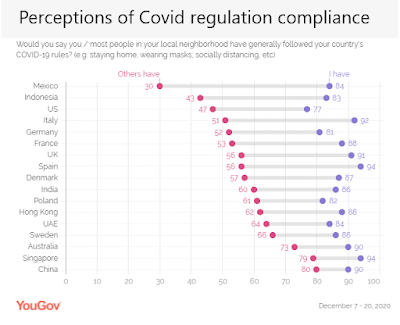
The chart shown above (based on
a survey conducted by YouGov, an international research data and analytics
group) suggests an important reason why the effectiveness of lockdowns is
likely to depend on context. Willingness to comply with such regulations is
much higher in some countries than others. I think the relatively high
compliance level in Australia reflects strong public support for the
regulations rather than the substantial penalties that applied if
non-compliance was detected. The regulations were difficult to police even in
the presence of strong public support, and would have been impossible to police
if blatant non-compliance had become widespread.
Would it be desirable to adopt a uniform approach in all
jurisdictions?
Differences in support for regulation and associated
differences in willingness to comply, are good reasons for different approaches
to be adopted in different jurisdictions.
Frijters et al suggest a more fundamental reason why a diversity
of approaches is desirable. After noting the value of state-level experiments
in the United States, including the minimalist policies adopted in South
Dakota, the authors suggest:
“The provocative takeaway is that the intelligence of a
whole country is enhanced when it contains communities adhering to truths
completely opposed to those of the intellectual elites. That takeaway is,
moreover, a deep lesson from history that Western countries have embedded into
their institutions over centuries. It has been remarked upon before by
historians that competition between radically different systems leads Western countries
to learn faster than more centralised places like China.”
What should we learn from the policies adopted in East
Asia?
The experience of East Asian
countries in preventing deaths from COVD-19 has been held up as example for
others to follow. For example, an article by Mingming Ma, Shun Wang, and Fengyu Wu, published as Chapter
3 of World Happiness Report 2021, concludes as follows:
“In general, we find that the
relatively successful story of the five East Asian regions, compared with the
six western societies, can be attributed to the stronger and more prompt
government responses and better civic cooperation. Except for Japan, all of the
East Asian governments implemented more stringent mobility control and physical
distancing policies, as well as more comprehensive testing and contact tracing,
especially at the early stages of the outbreak. A summary of the government
interventions and anti-COVID measures in the East Asian regions indicates that
a combination of strong government response systems, early and rigorous
mobility control, extensive screening, testing, contact tracing and isolation,
coordinated resource allocation, clear communication, enforced self-protection
practice, and supportive economic measures are important in fighting COVID-19
outbreaks and resurgence.”
The five East Asian
jurisdictions referred to are China, Hong Kong, Taiwan, Japan, and South Korea.
The six Western countries included in the study for comparative purposes were France,
Germany, Italy, Spain, the United Kingdom, and the United States.
The authors seem to be suggesting that all the
East Asian jurisdictions adopted stringent policy responses.
Frijters et al reach a different
conclusion using the same data on policy stringency in a study published in
Chapter 3 of The Great Covid Panic. The authors group countries and
regions into three categories, Minimalists, Pragmatists, and Covid Cults, on
the basis of the stringency of the average stringency of their policies during
2020. They found that the minimalists had far fewer claimed Covid deaths than
either the pragmatists or the cults and that the pragmatists accumulated only a
little over half the death rate of the cults.
It is interesting that most of
the East Asian jurisdictions referred to in the first study were classified as
either minimalists or pragmatists. Taiwan and Japan were classified as
minimalist, and South Korea was classified as pragmatist. The United States and
most European countries were classified as cults, along with China, Australia
and New Zealand.
It is certainly difficult to
maintain that stringency has been a major factor explaining the relative
success of policy responses in the East Asia region. I am not sure what other conclusions can be
drawn, except that further study will be required if we are to learn from the
experiences of countries adopting different policy responses.
How should we be thinking
about government intervention?
Many politicians and other
commentators seem to imply that apart from lives lost (or saved) the only other
factor that needs to be considered in evaluating policy responses to COVID-19
is their impact on GDP. Far too little account is taken of the future
consequences of increases in public debt that have been incurred to support
people during lockdowns and the psychological impacts of restricting social
interactions for long periods.
When freedom is mentioned by
advocates of stringent regulation, it is often viewed as something frivolous that
must be sacrificed to prevent deaths from Covid. That is the way a bureaucrat
might view the options if given prevention of deaths from Covid as a key
performance indicator (KPI). Within that mindset, freedom must be sacrificed to
a sufficient extent to ensure that lockdowns work. Prevention of deaths from
Covid is seen as being of utmost importance. Just as some soldiers have claimed
that they had to destroy villages in order to save them, the single-minded
advocates of lockdowns seem to be willing to destroy people’s lives in order to
save them.
I am not implying that freedom
is more important than health, or that liberty is more important than human
flourishing. I am just suggesting that it is unhelpful to view the issues in
that way.
About 15 years ago, after
reading some of the writings of Douglas Rasmussen and Douglas Den Uyl, I
realized that it makes no sense to think in terms of a need to choose whether
priority should be given to liberty or to human flourishing. Human flourishing
does not exist apart from the flourishing of individuals, and the flourishing
of individuals is not possible without opportunities for self-direction. Once
we recognize the importance of self-direction to individual flourishing, that
poses the question of what rules of the game – or political / legal order - would
allow greatest opportunities for individual self-direction. Liberty is the answer!
The protection of individual liberty – or the natural rights of individuals –
provides the context in which individuals can flourish in different ways,
provided they do not interfere with the rights of others. (You can find further
explanation and links to the works of Rasmussen and Den Uyl in my book, Freedom,
Progress, and Human Flourishing.)
Recognition of the foundational
role of liberty doesn’t tell us what rules of the game should apply in a
pandemic. However, it does tell us that we should be looking for rules of just
conduct that would provide an appropriate balance between the different
interests of individuals in getting on with their lives and avoiding exposure
to infection.
The discussion earlier in this
article suggests:
- The most appropriate rules in any society must depend, to a large extent, on the degree of support for them.
- A diversity of approaches in different jurisdictions is highly desirable to provide greater opportunities to learn from the experience of others.
- Different interpretations of the East Asian experience suggests that some caution is required to ensure that we learn the right lessons from the experience of others.


