Monday, May 23, 2022

What were the highlights of my trip to India?


This photo of me at the Gateway to India in Mumbai was taken on May 13 at the end of my 16-day visit to northern India. This colonial monument was built to commemorate the visit of King George V in 1911, but is now one of the prime tourist attractions in Mumbai.

As I walked among the people visiting the monument, I was bemused by the thought that I might be the only foreign tourist among them. 

I felt welcome. As occurred several times during my holiday, some local people struck up conversation with me, asking where I was from (and how many children I had).

My hat was another common topic of conversation. Several people asked where they could buy a hat like my Akubra during the “golden triangle” leg of my journey (Delhi, Agra, Jaipur) when the maximum daily temperature was about 45 degrees Celsius (113 F). The heat didn’t bother me as much as the poor air quality. The only time I felt distressed by the heat was at Agra Fort, which tends to absorb heat. My hat certainly helped and I had respite when I was being driven from place to place in an airconditioned car. Many local people are not so fortunate – media reports suggest that some have suffered heat stroke.

Why visit northern India?

I have wanted to visit India for as long as I can remember, so when I heard that India was again welcoming tourists, it seemed like a good idea to take advantage of the opportunity before I became much older. (I also hoped that the timing of the trip would enable me to avoid being exposed to an unedifying election campaign in Australia, but the election was held later than I had anticipated.) There were two places in India I particularly wanted to visit: Daman, the former Portuguese colony north of Mumbai; and the state of Meghalaya in the north-east. Daman was of interest because an ancestor with a Portuguese name, who migrated to Australian in the 1850s, was born in Daman. I had several reasons for wanting to visit Meghalaya – I had become interested in the cultural history of the north-east of India after visiting Bhutan a decade earlier and was curious about the description of Meghalaya as the Scotland of India. Most importantly, I like waterfalls.

Since this was my first visit to India, I also wanted to include the golden triangle in the program, and was interested to see Kolkata and Mumbai.

Organisation

The trip was organized through Rough Guides Trips, a British firm. The detailed planning was managed in India by Bharathi Uveka (Indian Stories and Travel X). Bharathi was extremely helpful in developing a program that suited my requirements as an old person who wanted to stay in good hotels, be driven around, and have guides explain what I was seeing. Bharathi and her assistant (Shaju K) stayed in touch during the tour to provide information and to ensure everything was happening as planned. There are cheaper ways to visit India, but I am satisfied that I obtained good value for money.

I think the quality of the hotels I stayed in helped me to avoid any stomach upsets. I also took appropriate precautions, including imbibing some whisky every evening.

In what follows I am highlighting some of the sightseeing aspects of my trip. I will leave discussion of more serious topics to later articles.

Highlights of the Golden Triangle

It is difficult to select just one aspect of my trip to Delhi as a highlight. My Delhi guide, Raj (Rajender Rathore) took me to several interesting places, including a Sikh temple and memorials to Gandhi. 

However, being transported through the narrow streets of Old Delhi by bicycle rickshaw was like nothing else I have previously experienced.


I have selected the Taj Mahal as the highlight of my trip to Agra. That will probably not surprise anyone, but the Taj receives so much publicity that I was half-expecting to be disappointed. Having now seen the building, I think it deserves all the praise that it has received. My guide, Neeraj Chnwada, arranged for me to see the Taj from several angles, and to observe it change color in the evening.


One of the highlights of my journey from Agra to Jaipur was a visit to Chand Baori. The step-well in the foreground dates from the 8th century, with upper stories built in the 18th century, during the Mughal era.


The driver for the Golden Triangle leg of my journey, Pratap Bhati Singh, arranged for me to visit Chand Baori and some other sites as an addition to the itinerary.

Bhati - that is what he told me to call him – also assisted in other ways including by providing help in navigating the process of obtaining an Indian sim card for my mobile phone, and giving helpful hints on how to use ATMs (e.g. don’t ask for more than INR 10, 000 in one transaction).  

A visit to Jantar Mantar was one of the highlights of my visit to Jaipur. This site, which contains a collection of 19 astronomical instruments for measuring time, predicting eclipses etc. The monument was completed in 1734.
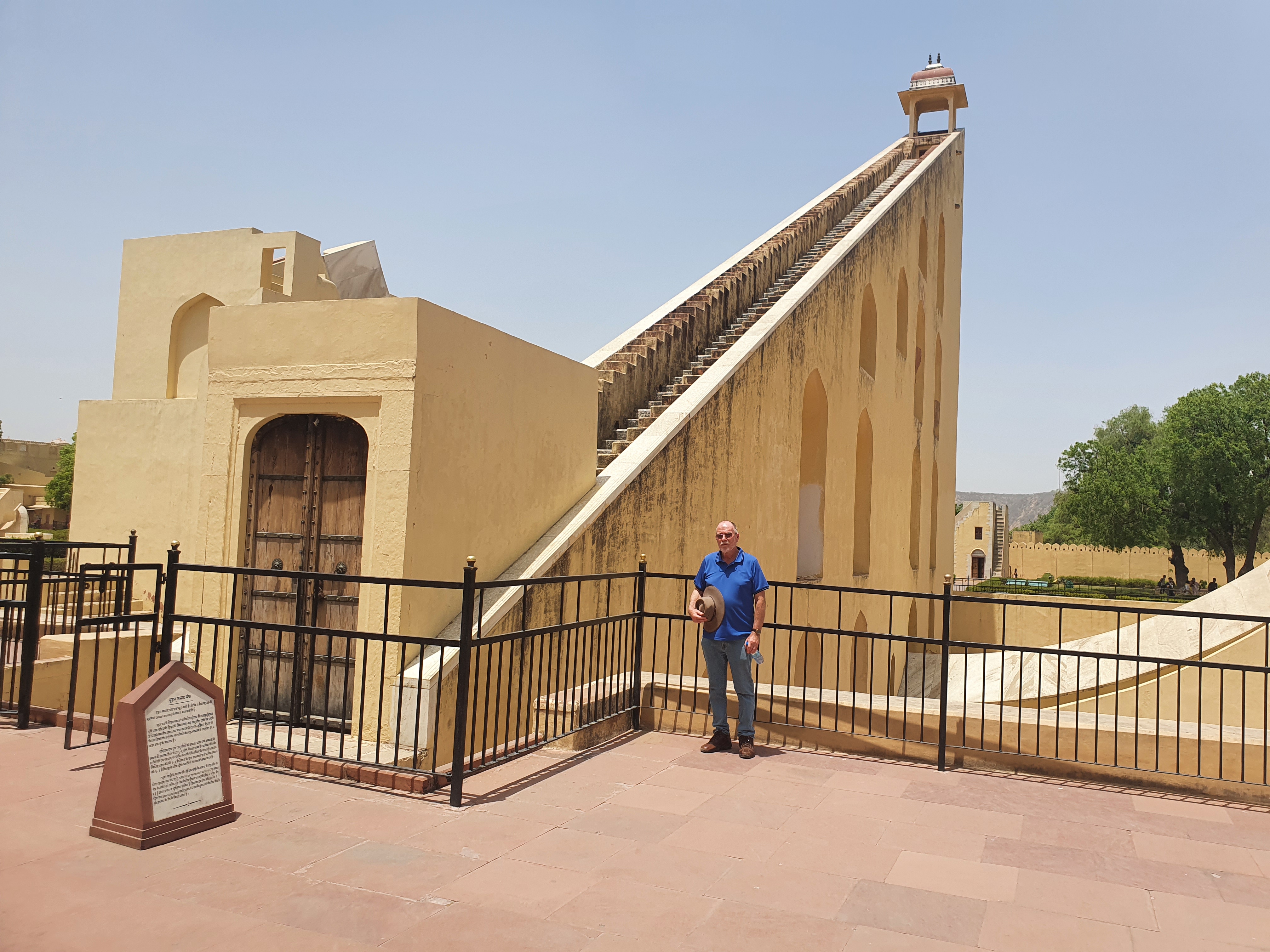


My guide in Jaipur, Abishek Shrivastava, is a hero. As well as providing historical information, he caught my hat when it was blown off my head by a gust of wind, he rescued my phone after it slipped from my fingers and fell about 3 meters to the bottom of an instrument at the astronomical museum, he read my aura, and he found a post office where I could buy stamps for letters to send to my grandchildren. (Unfortunately, the postal services have not cooperated to ensure timely delivery of the letters – it is now more than 3 weeks since they were posted, and they still have not arrived.)


Kolkata

From a sightseeing perspective, the flower market was a highlight of my trip to Kolkata. 


My guide, Vikash, introduced me to drinking Masala Chai the Kolkata way, in disposable clay cups, and provided insights about the history of Kolkata. I will discuss colonial history in a later article, but I want to note for future reference that the comparative economic performance of West Bengal and other Indian states over the last 50 years may provide a useful case study of the effects of socialism.


Meghalaya

Waterfalls were the sightseeing highlight of my visit to Meghalaya. However, rather than showing photos of many waterfalls, I will discuss my visit to the double decker living root bridge and Rainbow Falls at Nongriat. The first photo is of my local guide from the village and a few of the 3800 steps that needed to be traversed.


The second photo is of the double decker root bridge.


The third photo is of me at Rainbow Falls.


The feeling of achievement after visiting Rainbow Falls made it worthwhile, but I was a silly old fool to think that my good health and regular walking habits would make this fairly easy to accomplish. In retrospect, I should have prepared by undertaking some specific fitness training.

It took much longer than expected for me to climb back up the hill. I am most grateful to the local guide, shown earlier, and my guide for Meghalaya, Mr. Dipankar (below) for their support and patience. I am also grateful to my driver, Mr. Simitar, who came looking for us when we were overdue at the car park.


I felt no ill-effects next morning after the exercise the previous day, but after sitting in cars and planes for the next couple of days, I felt stiff and sore by the time I arrived in Daman.

Daman

The highlight of my stay in Daman was to visit churches and other sites that my great, great grandfather might have visited. The first photo shows a local guide (a university student) with my driver, Jeevachh Singh, and myself in front of one of the churches.


Mumbai

The guide for my Mumbai visit, Rupali D’Souza, took me to Mani Bhavan, a museum which was Gandhi’s residence in Bombay from 1917 to 1934. The display of the famous salt march, pictured behind Rupali, is an example of the series which capture major events in the life of Gandhi.


It was a privilege to visit this museum. While in Delhi I had visited the place of Gandhi’s assassination and his tomb, so this completed the circle. The opportunity to remember Gandhi’s contribution to the world was certainly one of the highlights of my visit to India.

Postscript

I neglected to mention food. Indian food was definitely one of the highlights of my trip.


Saturday, April 9, 2022

How should Lachlan Macquarie be remembered?


Lachlan Macquarie was governor of New South Wales from 1810 to 1821. At that time, the colony comprised much of the Australian mainland (known then as New Holland), Tasmania (Van Diemen’s Land) and other island territories.

Many years ago, when I studied Australian history at school, I came to the view that Macquarie, the fifth governor of New South Wales, was one of the best of the colonial governors. I still feel that Macquarie made a positive contribution to cultural values that are widely held in Australia today. It is unusual for despots to be good people, but I think Macquarie was one.

The above photo is of a sculpture of Lachlan Macquarie, located by Macquarie Street in Sydney. The inscription on the plaque describes Macquarie as “a perfect gentleman”, while that on his tomb in Scotland describes him as “The Father of Australia”.

Macquarie is also remembered in the many places named after him. Some that readily come to mind are the suburb of Canberra, where my family lived for several years; Port Macquarie, on the north coast of New South Wales, where we have enjoyed some holidays; and Lake Macquarie, where we now live.

Proposal to re-name Lake Macquarie


I have been prompted to write this article because there is currently a move for Lake Macquarie to revert to its original name, Awaba. The Indigenous inhabits of the region, Awabakal people, knew the lake by that name for many thousands of years prior to European settlement. I see no reason to oppose the name change if it can be accomplished without a great deal of cost and confusion, and in a spirit of reconciliation.

However, some of the proponents of the name change seem to me to be making it difficult for it to be accomplished in a spirit of reconciliation because they are arguing that Lachlan Macquarie does not deserve to be honoured. It looks to me as though they want him to be cancelled!

Those who seek to denigrate Macquarie refer to the fact that he ordered a military operation that led to a massacre of aboriginal people. They don’t have regard to the circumstances in which that order was given, or consider what alternative courses of action Macquarie could have taken.

What would you have done in his shoes?

I can understand why some readers might object to the idea of contemplating what it might be like to occupy the shoes of a colonial despot. Some might argue that those shoes did not have to be filled. The British could have chosen not to establish the colony in the first place. They could have found some other way to solve their problem of over-crowded prisons, and thus avoided encroaching upon the lands of Indigenous people.

However, as I see it, if similar choices to those confronting Macquarie were not faced by an alternative British despot, they would have been faced by a despot from France or some other European country. When Britain established the colony, other European powers were seeking to establish colonies throughout the world. So, if the British had not established the colony, it is highly unlikely that the Indigenous people would have been left alone to pursue their traditional lifestyles.


Lachlan Macquarie was a reluctant appointee to the position of governor.  The biographical history by M H Ellis indicates that after having served with the British army in India for 25 years, Macquarie considered it to be unfair that he was being posted to the colony. (Ellis, 166)

In contemplating what you would have done in Macquarie’s shoes, it might be helpful to consider his motives, the circumstances that led to the military operation, and whether alternative approaches might have led to more tranquil relations between Indigenous people and settlers.


Macquarie’s motives

On arrival in the colony, Macquarie expressed the wish that “the natives of the country, when they came in the way in a peaceable manner, might not be molested in their persons and property by anyone, but that they should always be treated with kindness and attention, so as to conciliate them as much as possible to the British Government and manners.”  (Ellis, 179)

How could Macquarie expect the Indigenous people to remain peaceable when their land was being taken away from them? I see some evidence that Macquarie saw potential for mutual benefit from more productive use of the land, and by helping Indigenous people to develop new skills and habits. From his paternalistic perspective, the Indigenous people were wasting their lives “in wandering thro’ their native woods … in quest of the immediate means of subsistence”. He saw them as having qualities that “if properly cultivated and encouraged might render them not only less wretched and destitute” but “progressively useful to the country according to their capabilities”. He expressed the view that they could “advance toward a state of comfort and security”. (Ellis, 352-3).

Macquarie allocated some land for use by Indigenous people on the grounds that they were “a harmless race, who have been without struggle driven by the progress of British industry from their ancient places of habitation”. (Ellis, 358)

Unfortunately, Macquarie received only lukewarm support for this approach from the British government. If the policy had been pursued vigorously by the British government, the Indigenous people would not have suffered such great deprivation and humiliation in subsequent decades.

Circumstances that led to the massacre

A deterioration in relations between Indigenous people and European settlers seems to have occurred in 1814 mainly because the settlers retaliated when Indigenous people helped themselves to unfenced fields of corn planted by the settlers. Macquarie saw fault on both sides. As he saw it, there had been a violation of property rights by the Indigenous people, but it was not a serious violation. He admonished the settlers to behave with patience and forbearance and not to take the law into their own hands. He warned that future aggressiveness by either whites or blacks would be punished in an exemplary manner. (Ellis, 353-4)

Nevertheless, attacks on settlers continued and some abandoned their farms. The governor felt that a severe response was required to prevent the frequent occurrence of trouble. In April 1816 he ordered a military action to drive the mountain tribes a safe distance from the settlement.  (Ellis, 355-6) Those seeking an account of the massacre can find relevant documents on the Australian Museum website. In a subsequent proclamation, Macquarie gave settlers the right to drive away Indigenous people who appeared armed with weapons within a mile of any town, village, or farm.

The military action had the desired effect of restoring order. Members of local tribes attended a friendly meeting which the governor held in December 1816 to, among other things, consult with them “on the best means of improving their present condition”.

Alternative approaches

The limits of my knowledge of the relevant history make it difficult for me to assess the options that faced Macquarie. Perhaps there was potential for him to restore order by adopting a response that was targeted to a greater extent at individual perpetrators of violence rather than on tribes of people, but I have not seen any authoritative discussion of that possibility.

It seems unlikely that Macquarie would have considered the option of attempting to achieve peace by limiting the area of European settlement. That approach would have been likely to lead to rebellion by the settlers and Macquarie’s replacement as governor.

The governor could have continued to pursue a conciliatory approach but there is no reason to believe that would have been successful in discouraging attacks on settlers, or setter retaliation. The most likely outcome, it seems to me, would have been an increase in violence on both sides, with a more extensive military intervention required eventually to end the conflict.

Concluding comments

My view that Lachlan Macquarie made a positive contribution to cultural values that are widely held in Australia today is based mainly on the humane approach he adopted toward the people of the colony. He has been remembered particularly for his humane treatment of convicts and ex-convicts, who made up about 90 percent of the European population of the colony at the time of his appointment. Macquarie saw that some of the most meritorious people in the colony had come there as convicts and sought to treat them justly by giving them the opportunities to hold responsible positions.

Macquarie sought to extend this humane approach to the indigenous people, but was faced with difficult choices. Those who criticize the choices he made should consider what they would have done in his shoes.