Showing posts with label Enlightenment. Show all posts

Sunday, August 16, 2026

What can Libertarians Learn from Foucault?


Before reading Mark Pennington’s recent book, Foucault and Liberal Political Economy: Power, Knowledge, and Freedom, it would not have occurred to me that libertarians could learn anything from the social theories of Michel Foucault. Pennington has persuaded me that some beliefs associated with Foucault, and postmodernism more generally, are not devoid of merit. As will be discussed below, however, the beliefs that he identifies as postmodern differ somewhat from the collection of beliefs that I have hitherto associated with postmodernism.

Pennington claims that liberals who are concerned about over-government can learn from Foucault about “multiple sources and potential forms of this ‘over-government’ in modern societies and how these threats to freedom have been neglected by, and in some cases resulted from, the dominant strands in liberal thought”.

The author aims “to enunciate the elements of a postmodern liberalism, and to show how this perspective might engage in a productive conversation with Foucault in ways that expose the illiberalism of contemporary societies and the dominant forms of social science and political philosophy that contribute to this state of affairs”.

Before considering Pennington’s claims about what liberals can learn from Foucault and the potential for liberals to engage productively with his ideas, I need to clarify how Pennington is able to argue that some of Foucault’s views are worthy of consideration and what Pennington means by “postmodern liberalism”.

Foucault’s views

 The main problem I have with the postmodernist movement is its disrespect for reason, truth and knowledge. Stephen Hicks suggests that Foucault’s views illustrate the direction and tone of the postmodern intellectual world:

“Michel Foucault has identified the major targets: “All my analyses are against the idea of universal necessities in human existence.” Such necessities must be swept aside as baggage from the past: “It is meaningless to speak in the name of—or against—Reason, Truth, or Knowledge”.” (The sources of the quoted passages are cited in Hicks, 2004.)

Hicks explains that Foucault reduces knowledge to an expression of social power and urges that we play the brutal power politics game on behalf of the traditionally disempowered.

Pennington recognizes that Foucault has often been accused of undercutting the basis of his own critical analysis:

“If all knowledge is reflective of an arbitrary ‘will to truth’, then what of Foucault’s own truth claims?” 

More specifically:

“If all truth claims are understood as merely a way of exercising power over others, then how are people to know which if any of the ‘intolerable’ practices they find themselves in are worth challenging or resisting, let alone what might replace them.”

However, Pennington observes that there are many Foucaults, “reflected in the shifting emphases, styles of analysis and reinterpretations of his own words”:    

“Towards the end of his life … notably in essays such as ‘What Is Enlightenment?’, Foucault softened the power/knowledge coupling, adopting a stance that does not deny that there are better and worse forms of argument or that there are some more or less valid forms of knowledge; rather, he emphasises the importance of uncertainty, of keeping all truth claims under scrutiny, and of being aware of the routinised social processes that might block that very scrutiny.”

If postmodernism is characterized by the idea that truth claims merely reflect the exercise of social power, perhaps it could be said that towards the end of his life, Foucault’s views became somewhat less postmodern.

 Postmodern liberalism

In outlining the elements of “postmodern liberalism” Pennington notes:

“This ‘postmodern’ liberalism has not previously been coherently articulated, but strands of it are detectable in the writings of F. A Hayek, those of Deirdre McCloskey, and elements of the contemporary Austrian school of economics, as well as in the context of political philosophy apart from Hayek in the works of Michael Oakeshott, Gerald Gaus, and Chandran Kukathas.”

I have considerable knowledge of the views of some of those authors and great respect for all of them. I am not comfortable with their views being labelled as postmodern, even though some of them might not object to that label.

Pennington seems to me to be distancing “postmodern liberalism” from postmodernism when he acknowledges that it is possible to assess “the comparative plausibility of competing narrative explanations” and “social scientific truth claims”.

In his concluding chapter Pennington notes that the elements of “postmodern liberalism” include, among other things, a “philosophy of social science sceptical of socio-economic positivism and the efforts of conscious control it fosters”.

It seems to me that Pennington’s philosophy of social science could appropriately be labelled “unpretentious liberalism”. It stands apart from the pretence of knowledge and scientism associated with socio-economic positivism, without endorsing postmodernism’s disrespect for reason, truth and knowledge.

I hope the book will attract many readers who identify as postmodernists and that they will be captivated by the concept of postmodern liberalism. However, those who (like me) are allergic to postmodernism, may find the book easier to read if they substitute the words “unpretentious liberalism” whenever they see “postmodernism liberalism”.

Should libertarians attempt to influence culture?

Before considering what libertarians can learn from Foucault, it seems appropriate to acknowledge that there is nothing new about the idea that libertarians should take an interest in culture.

That is apparent in the consideration of interactions between culture and political institutions in a discussion between Chris Matthew Sciabarra and me entitled, “Should Libertarians be Attempting to Influence Culture?” which published on this blog in September 2024. The discussion began by considering John Stuart Mill’s concerns about the “tyranny of the prevailing opinion and feeling” and moved from there to considering Sciabarra’s interpretation of Ayn Rand’s view of power relationships. Sciabarra presented a Tri-level Model of Power Relations which was first derived from his reconstruction of Ayn Rand’s critical analyses of social problems, outlined in Part Three of Ayn Rand: The Russian Radical (Sciabarra, 2013).

In introducing his discussion of Rand’s view of power relationships, Chris Sciabarra commented:

“Winton suggests that Enlightenment humanism has been preoccupied with reason and reality, while postmodernism has been preoccupied with the use of power. Hence, it is startling that Rand, who most certainly placed herself in the reason and reality camp, also emerged with a critique of power relations.”

The question under discussion provoked responses from several libertarians and classical liberals. The response of Douglass Rasmussen, joint author of Norms of Liberty (Rasmussen and Den Uyl, 2005) is pertinent to this essay:

“Is there not a difference between saying libertarianism qua political philosophy should attempt to change culture and saying that a libertarian concerned in advancing libertarianism should attempt to change culture? The former concerns what the political/legal order should do, and the latter concerns what individuals should do.”

As I see it, attempting to understand the consequences for liberty and individual flourishing of interactions between culture, markets, social movements and government regulation does not obviate or preclude attempts to define the nature of a political/legal order that can ensure that individuals can flourish in different ways without colliding.

Foucault’s liberalism

 From my perspective, one of the most interesting aspects of Foucault’s philosophy, as discussed by Pennington, is his account of discourses as a kind of spontaneous order phenomenon.  Foucault challenges the role of individual or collective agency in the operation of power regimes. Power works through chainlike or network effects. As people adopt certain discourses they influence the actions of others.

Power does not emanate from a single point in a network. It emerges from diverse and at time contradictory attempts by actors to assert their place in society. There is no identifiable author of power relations. As Pennington puts it:

“The discourses and disciplines producing people’s patterns of thought, positionality and interests are largely unintended consequences of the multiple attempts to affect the conduct of others.”

 Thus, while power relations may appear to have a coherent structure, there is no single purpose, intention, or meaning that underlies that structure.

States of domination arise when a set of discourses align or crystalize with each other and with the juridical power of the state. Scientific discourses can pose a problem where people come to be classified relative to various norms (e.g. as deviant, perverted, insane) and subjected to discipline (which may include social punishments). In addition, bio-power operates through interventions to change social, economic or environmental conditions in the name of improving population health or providing security.

Pennington suggests that “it is with Foucault’s concept of bio-power and especially its economic manifestations where the most significant possibilities for a dialogue between the Foucauldian and postmodern liberal perspectives lies”. Late in Foucault’s career he “seems to favour an environment that preserves a ‘pluralism of rationalities’ so that people might remain alert to the possibility of multiple ways of their being governed and not being frozen into a particular classificatory grid and the roles and positions it creates”.

In my view, Foucault’s decentred account of power relations is often more plausible than theories which reduce the exercise of power to holding of positions in political office. A decentred account is consistent with the conclusion of my recent series of essays on political entrepreneurship. Even though it is possible to identify the policies adopted in some countries with the ideologies of authoritarian political leaders, I suggest:

“The problem of ensuring adoption of government policies that more consistently advance economic and personal freedom cannot be reduced to the question of how to elect better political entrepreneurs to national leadership positions. Institutional change is a complex process involving social movements, media organizations, and interactions between individual citizens, as well as local and national politics.”

I concur with Pennington that Foucault’s view of power relations provides support for an unpretentious liberalism which is deeply skeptical of economic and philosophical approaches which presuppose that the welfare of the population can be secured by a form of expert rule.

In Part II of his book, Pennington uses his theoretical lens to examine complex networks of institutional, physical, and administrative mechanisms and knowledge structures associated with social justice, public health, ecological sustainability, and crime and punishment. He critically examines various overlapping systems of power - some focused on managing populations and others focused on guiding individuals. (In this paragraph I have relied on Claude, Anthropic's AI assistant, to help translate the technical Foucauldian phrasing in Pennington’s summary – words including “dispositifs”, “bio-political” and “pastoral” - into plainer English.)

These systems share three features: (1) an excessive faith that social and economic life can be understood and controlled with scientific precision, (2) a belief that some central “steering” intelligence can identify and fix deviations from expected patterns, and (3) a bureaucratic, top-down way of handling risk. The author demonstrates that these features tend to shrink the space in which individuals can act freely.

Conclusion

So, what can libertarians learn from Foucault? Pennington's answer, as I read it, is not that libertarians should adopt postmodernism's skepticism of reason and truth - that skepticism, taken to its logical end, undercuts the very possibility of arguing for freedom over domination. Rather, what is valuable in Foucault is his decentred account of power: the recognition that domination need not flow from a single source or a deliberate design, but can emerge from the unintended convergence of discourses, institutions, and expert classifications. This is a lesson that liberals have sometimes neglected, having focused their concern about over-government on the formal power of the state while overlooking the more diffuse mechanisms in social justice, public health, ecological policy, and criminal justice that narrow the space for individuals to govern their own lives.

What Pennington calls postmodern liberalism – I prefer to call it "unpretentious liberalism" - captures what is worth taking from this encounter: a liberalism skeptical of the pretence of expert knowledge and socio-economic positivism, without embracing postmodernism's disrespect for reason and truth. Pennington's Foucault, particularly the later Foucault of "What Is Enlightenment?", is compatible with this project because he does not deny that some truth claims are better than others - he simply insists that we remain alert to the ways power can masquerade as expertise, and that we preserve a plurality of ways of being governed rather than being frozen into a single classificatory grid. That, it seems to me, is a genuinely liberal insight, however unfamiliar its Foucauldian packaging may be to libertarians who have, like me, generally kept their distance from postmodern thought.

References

Hicks, Stephen R. C., Explaining Postmodernism (Scholargy Publishing, 2004).

Pennington, Mark, Foucault and Liberal Political Economy: Power, Knowledge, and Freedom (Oxford University Press, 2025).

Rasmussen, Douglas B., and Den Uyl, Douglas J, Norms of Liberty (Pennsylvania State University Press, 2005).

Sciabarra, Chris Matthew, Ayn Rand: The Russian Radical, Second Edition (Pennsylvania State University Press, 2013).


Thursday, July 16, 2026

Did the Enlighteners Reject Aristotle?


In his book, The Enlightenment: The Pursuit of Happiness 1680-1790, Ritchie Robertson uses the term “Enlighteners” to describe the proponents of the Enlightenment. I will briefly describe Robertson’s book before explaining how my reading of it has caused me to consider the question posed above.


The Enlightenment is monumental in terms of its discussion of the contributions of numerous Enlighteners and its detailed coverage of topics including science, religion, ethics, government, philosophy and revolution, as well as its length (983 pages, including references and index). The author has done well to make his tome interesting to read.

Robertson has a positive attitude toward the Enlighteners. He suggests that “the Enlightenment stands for the endeavours of thinkers, writers and practical administrators in many countries to increase the well-being of humanity”. In the Preface, he attempts to summarise what the Enlighteners sought to do:

“For them, to enlighten humanity is to clear away the false beliefs which have blinded people to their own interests; to oppose the power of institutions, especially the organized Churches, which have encouraged such blindness; to arrive at a true understanding of human nature, and of the political and economic societies in which people live; to increase people’s well-being and happiness; and to do so by close attention to empirical facts and the use of reason.”

In his concluding chapter, Robertson notes that critics of the Enlightenment sometimes refer to it as ‘the Enlightenment project” to imply that it can be reduced to a single model that is responsible for all the ills of modernity. The author aimed to provide a “fine-grained” presentation of “a rich and complex historical period, and a diverse body of thought”. Despite the criticism I offer below, I believe that Robertson has achieved that objective.

 Robertson’s book has been the subject of several extensive reviews since its first publication in 2020. Rather than attempting to provide a comprehensive review of The Enlightenment, I refer readers to a review by Gary Saul Morson entitled “Daring to Know” (Morson, 2021).

What prompted my question?

Chapter 1, entitled “Happiness, Reason and Passion”, opens with the following sentence:

“The Enlightenment declared the conviction that the goal of life was happiness, and that if this goal could be attained at all, it was to be found in the here and now.”

As I read that, the thought crossed my mind that Aristotle got there first. A few pages later, I thought the author was about to acknowledge the debt that the Enlighteners owed to Aristotle when he writes:

“The belief that the purpose of human life is the attainment of happiness is called ‘eudaemonism’.”

However, Aristotle doesn’t rate a mention. Instead, attention is focused on Epicurus, the bad odour that had surrounded that philosopher during the Middle Ages and the caution his admirers needed to display during that period.

I accept that there are grounds to argue that the beliefs that most Enlighteners had about happiness may have been closer to those of Epicurus than to those of Aristotle. As Darrin McMahon has observed, most Enlightenment thinkers tended to put greater emphasis on pleasure and good feeling than did Plato, Aristotle and the Stoics (McMahon, 2005, p.209).

Nevertheless, when I was reading Robertson’s book I expected that he would have mentioned Aristotle in his discussion of the Enlighteners’ views on happiness. Does that make me guilty of presentism – a tendency to see the past from a present day perspective?

From a present day perspective, it is not difficult to consider Aristotle’s views on their merits, disentangling them from the religious dogma of the Middle Ages. Perhaps it was more difficult for the Enlighteners to do that.

Did the Enlighteners reject Aristotle? That is a big question. I will confine myself to considering three relevant aspects:

 Did the Scientific Revolution discredit Aristotle?

Did any of the Enlighteners see merit in Aristotle’s views?

Would it make sense to view any of the influential Enlighteners as Neo-Aristotelians?

The Scientific Revolution

Francis Bacon and Galileo Galilei played major roles in the Scientific Revolution which preceded the Enlightenment.

Robertson notes that Bacon “rejected the empty abstractions of scholastics who immersed themselves in Aristotle and ignored the world around them”. He also notes: “Bacon’s dismissal of Aristotelian abstractions was supported by such hands-on experimenters as Robert Boyle.”

Although Robertson discusses Galileo’s contributions, he doesn’t mention his view of Aristotle. John Sellars has pointed out that although Galileo mocked those who adhered slavishly to the letter of Aristotle’s works regardless of what new evidence might be presented, he suggested that “if Aristotle were now alive, he would change his opinion”. Aristotle would not have held on to beliefs that conflicted with new evidence. Sellars notes that Jacopo Zabarella and Alessandro Piccolomini had previously suggested that a true Aristotelian would embrace Aristotle’s spirit of inquiry. Piccolomini asserted that he would rely first and foremost on experience and observation, even if that meant disagreeing with Aristotle from time to time (Sellars, 2023, pp. 106-7).

If the Enlighteners felt inclined, it was possible for them to discuss Aristotle without being seen to endorse everything he wrote.

Enlighteners who saw merit in Aristotle’s views

Francis Hutcheson and Adam Smith saw some merit in Aristotle’s views.

Hutcheson was one of the most influential figures of the Scottish Enlightenment. Robertson notes that a central point in Hutcheson’s moral philosophy was that moral goodness denotes “a quality in actions which makes us approve the action, and love the actor, even though it does not serve our advantage”. By suggesting that humans possess a moral sense, Hutcheson was differing from the view of Epicureans that humans are motivated only to avoid pain and seek pleasure.

In developing his own philosophy, Hutcheson referred to Aristotle’s view of happiness:

“Thus according to the just observation of Aristotle, “The chief happiness of active beings must arise from action; and that not from action of every sort, but from that sort to which their nature is adapted, and which is recommended by nature.” When we gratify the bodily appetites, there is an immediate sense of pleasure, such as the brutes enjoy, but no further satisfaction; no sense of dignity upon reflection, no good-liking of others for their being thus employed. There is an exercise of some other bodily powers which seems more manly and graceful. There is a manifest gradation; some fine tastes in the ingenious arts are still more agreeable; the exercise is delightful; the works are pleasant to the spectator, and reputable to the artist. The exercise of the higher powers of the understanding, in discovery of truth, and just reasoning, is more esteemable, when the subjects are important. But the noblest of all are the virtuous affections and actions, the objects of the moral sense” (Hutcheson, 1755, Ch.ii).

In A System of Moral Philosophy, Hutcheson made many favourable references to Aristotle. The main point on which he expressed opposition was in respect of Aristotle’s view that some people are “natural” slaves.

Adam Smith considered the views of Aristotle, along with those of Plato, Zeno and Epicurus, in Theory of Moral Sentiments. His discussion of Aristotle’s moral philosophy is respectful of the idea that virtue is a middle state between extremes of excess and deficiency. One example he cites is that magnanimity lies between “the excess of arrogance and the defect of pusillanimity, of which the one consists in too extravagant, the other in too weak a sentiment of our own worth and dignity”. Smith goes on to note Aristotle’s emphasis on the development of good habits (Smith, 1984/1759, VII.ii.1, para.11-14).

Smith suggested that the moral philosophy of Epicurus “is, no doubt, altogether inconsistent” with that which he had been endeavouring to establish” (Smith, 1984/1759, VII.ii.1.2. para.13). He noted that for Epicurus virtue was only to be pursued to prevent pain and to procure ease and pleasure. By contrast, Plato, Aristotle and Zeno had a different view:

“Man, they thought, being born for action, his happiness must consist, not merely in the agreeableness of his passive sensations, but also in the propriety of his active exertions” (Smith, 1984/1759, VII.ii.1.2. para.17).

Immanuel Kant was another Enlightenment philosopher who saw merit in some of Aristotle’s views. In the preface to the second edition of the Critique of Pure Reason, Kant said formal logic had not been able to advance a single step since Aristotle established it,and, thus, to all appearance has reached its completion” (Kant, 1787). The field of formal logic is somewhat removed from happiness and virtue ethics, but it is worth noting that Kant treats Aristotle as having essentially perfected an entire field of inquiry.

Neo-Aristotelian Enlighteners?

It is probably fair to say that few of the influential Enlightenment philosophers would have been comfortable being labelled as Aristotelians. When we look at the writings of some of them through modern eyes, however, the influence of Aristotle seems striking. Aristotelian ideas about human flourishing as reason-guided and connected to human nature seems to have been thoroughly absorbed into the natural law tradition (partly through Aquinas and the scholastics) that some Enlighteners could apparently express an Aristotelian viewpoint without feeling any need to invoke Aristotle by name.

Johann Gottfried Herder (1744-1803) is one of the main characters in Robertson’s book. Unfortunately, however, Robertson doesn’t draw out the parallels between the viewpoints of Aristotle and Herder.

Herder’s philosophy of history has an Aristotelian flavor because it was founded on the study of human nature. Herder’s concept of humanität – the goal toward which individuals are striving – seems to have a lot in common with Aristotle’s concept of ergon, and the idea that exercising reason and virtue defines what it means to be a human. Herder treats reason and humanity's distinctive powers as central to human flourishing.

In Herder's view, each culture has its own centre and specific form of happiness within itself - a conception of happiness as the actualisation of a being's specific nature and capacities, which is structurally very close to Aristotle's eudaimonia. In that respect, Herder’s account seems similar to that of modern Neo-Aristotelian classical liberals who emphasize that individuals may flourish in different ways in different communities and cultures.

I am indebted to Robertson for also bringing Jean-Jacques Burlamaqui (1694-1748) to my attention. Burlamaqui was a Genevan legal and political theorist. The passage in the epigraph at the beginning of this essay is taken from his book, The Principles of Natural and Politic Law. The longer quote from that book below serves to illustrate that it might be appropriate to view him as a Neo-Aristotelian Enlightener - his views certainly have much in common with those of some modern Neo-Aristotelians:  

“Happiness is that internal satisfaction of the soul which arises from the possession of good; good is whatever is agreeable to man for his preservation, perfection, entertainment, and pleasure. Evil is the opposite of good.

Man incessantly experiences, that there are some things convenient, and others inconvenient to him; that the former are not all equally convenient, but some more than others; in fine, that this conveniency depends, for the most part, on the use he knows how to make of things, and that the same thing which may suit him, using it after a certain manner and measure, becomes unsuitable when this use exceeds its limits. It is only therefore by investigating the nature of things, as also the relations they have between themselves and with us, that we are capable of discovering their fitness or disagreement with our felicity, of discerning good from evil, of ranging every thing in its proper order, of setting a right value upon each, and of regulating consequently our researches and desires.

But is there any other method of acquiring this discernment, but by forming just ideas of things and their relations, and by deducing from these first ideas the consequences that flow from thence by exact and close argumentations? Now it is reason alone that directs all these operations. Yet this is not all: for as in order to arrive at happiness, it is not sufficient to form just ideas of the nature and state of things, but it is also necessary that the will should be directed by those ideas and judgments in the series of our conduct; so it is certain, that nothing but reason can communicate and support in man the necessary strength for making a right use of liberty, and for determining in all cases according to the light of his understanding, in spite of all the impressions and motions that may lead him to a contrary pursuit.

Reason is therefore the only means, in every respect, that man has left to attain to happiness, and the principal end for which he has received it” (Burlamaqui,2006 /1763, Ch.V). 

Robertson notes that Burlamaqui’s book was a prescribed text at Harvard and Princeton universities and “helped to shape the minds of many later protagonists of the American Revolution”. He suggests that the influence of Burlamaqui’s views might help account for presence of the right to pursue happiness in the American Declaration of Independence.

I concluded a previous essay entitled,‘Why did the US Declaration of Independence specify an unalienable right to the pursuit of happiness?’ by suggesting that, in the American colonies at the time of the Declaration, pursuit of happiness “was widely perceived in terms that have a great deal in common with the activity of human flourishing, as perceived by Aristotle and his followers”.

Unfortunately, while drawing attention to Burlamaqui's influence on Jefferson's "pursuit of happiness", Robertson fails to point out that Burlamaqui's conception of happiness is thoroughly Aristotelian in structure. 

Conclusion

While reading Ritchie Robertson’s tome, The Enlightenment: The Pursuit of Happiness 1680-1790, I was struck by the absence of any reference to Aristotle in the author’s discussion of eudaimonia. That made me wonder whether I was guilty of presentism - perhaps I was reading the Enlightenment through modern eyes shaped by a renewed interest in Aristotelian ethics. On reflection, I do not think that charge holds. The resources for separating Aristotle from scholastic dogma were available to the Enlighteners themselves. Zabarella, Piccolomini and Galileo had already articulated the distinction between the letter and the spirit of Aristotle's work before the Enlightenment properly began. It was open to any serious thinker of the period to engage with Aristotle on his merits.

Did the Enlighteners reject Aristotle? Some prominent Enlighteners were explicitly opposed to Aristotle - Locke's version of the blank slate idea, Hume's empiricist scepticism, and Bentham's utilitarian calculus all represent deliberate departures from Aristotelian foundations. But as this essay has tried to show, that is far from the whole story. Hutcheson and Smith engaged respectfully and substantively with Aristotle's ethics. Kant credited him with having essentially completed an entire field of inquiry. And figures like Herder and Burlamaqui reproduced recognizably Aristotelian structures of thought about happiness and human flourishing, apparently without feeling the need to acknowledge the debt.

That last point is perhaps the most interesting one. Robertson himself draws attention to Burlamaqui's influence on Jefferson's "pursuit of happiness," yet does not notice that Burlamaqui's account of happiness - reason as the indispensable guide to the good life, directed toward the perfection of human nature - is thoroughly Aristotelian in character. A more Aristotle-aware reading of the Enlightenment would not diminish Robertson's achievement in mapping a rich and complex period. It would, however, complicate the familiar narrative in which the Enlightenment broke cleanly from ancient authority. The pursuit of happiness that Robertson places at the heart of the Enlightenment had stronger Aristotelian roots than he acknowledges.

References

Burlamaqui, Jean-Jacques, The Principles of Natural and Politic Law, trans. Thomas Nugent, ed. and with an Introduction by Peter Korkman (Liberty Fund, 2006/1763).

Hutcheson, Francis, A System of Moral Philosophy, Edited and with an Introduction by Knud Haakonssen and Christian Maurer (Liberty Fund, first published posthumously in 1755).

Kant, Immanuel, The Critique of Pure Reason, Translated by J. M. D. Meiklejohn (Project Gutenberg Ebook,1787).

McMahon, Darrin M., Happiness: A History (Grove Press, 2006).

Morson, Gary Saul, “Daring to Know” (Claremont Review of Books, Fall 2021).

Robertson, Ritchie, The Enlightenment: The Pursuit of Happiness 1680-1790 (Penguin Books, 2022).

Sellars, John, Aristotle: Understanding the World’s Greatest Philosopher (Penguin Books, 2023).

Smith, Adam, The Theory of Moral Sentiments, (Liberty Fund, 1984/1759).


Tuesday, March 1, 2022

Did Enlightenment thinkers believe that reason could illuminate all phenomena?


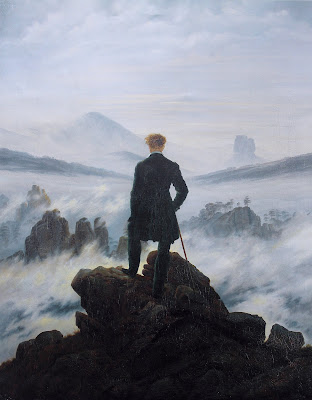
When I began to think about David Friedrich’s painting “Wanderer Above the Sea of Fog”, there seemed to be something odd about it. The painting reminded me of a TV news report I saw recently showing an Australian politician walking along a beach wearing a business suit. Both the politician and the “wanderer” seemed out of place. Perhaps the politician had a busy schedule which prevented him from changing into beach attire, but how can we explain the symbolism of the painting?

László Földényi, a Hungarian essayist, has suggested that the painting reflects the longing of Romantics to retreat from the fog of prosaic life “and find in nature that universal connection which civilization was supposedly unable to provide”. Földényi implies that, contrary to their intentions, the Romantics’ view of nature was similar to that of Enlightenment thinkers who viewed it as the object of rational and scientific thought:

“If we look at the wanderer in Friedrich’s painting, he appears to be giving himself over to nature, and yet at the same time he is decisively isolated from it. And this indicates to us that the Romantic “deification” of nature, its enlargement into a metaphysical category results in a tendency leading toward the violation of nature just as much as the openly technicist viewpoint does. For there too in the background lurks the intention to call to account, to seek proof and persuasion, the desire for nature to become the likeness of humanity, to be the mirror of our soul. In a word, the desire for nature to be pliable to their conceptions of it—even if, in certain cases, these conceptions differ from those of the natural scientists.”

The quoted passage is from Földényi’s book, Dostoyevsky reads Hegel and Bursts into Tears. The book
consists of 13 essays in which the author seeks to examine “the experience of inscrutability to be found in depths of all cultural phenomena.” He is attacking the “belief in the omnipotence of reason that illuminates all phenomena” which he believes to be “the great inheritance of the Enlightenment”.

Hegel is a prime target.

The title of the book comes from an essay in which Földényi speculates that Dostoyevsky may have read Hegel’s lectures on the philosophy of world history while exiled in Siberia and writing The House of the Dead. Hegel viewed world history as having a rational purpose and argued that the character of some nations is such that they don’t belong within the purview of world history. He ruled out Siberia as a setting for world culture.

Dostoyevsky suffered greatly in Siberia but felt his estrangement from world history to be a form of redemption from the gray rationality of European civilization. Exile enabled him to obtain a better understanding of other Russians and of himself.

Hegel is also the target of criticism in the final essay which discusses Elias Canetti’s book, Crowds and Power.  Földényi discusses the difficulty of attributing a genre to this book, telling readers that it is distinguished by its openness to metaphysical questions - particularly the ancient question, “What is man?” - and a capacity for amazement at the world.

Földényi suggests that “Canetti almost appears to be sending a message” to Hegel. Canetti was disturbed by “the arrogance of concepts” and held examination of individual phenomena to be more important that generalizations. He claimed that the conceptual interested him so little that he had not seriously read either Aristotle or Hegel.

Hegel believed in the fulfillment of history, but Canetti’s book is “a great pessimistic expression of the viewpoint that man is irreparable”, as he continually repeats brutal acts “while employing ever more refined means”. According to Canetti, Europeans live in an ocean of myth, mistakenly thinking that their rationalism is the fulfillment of history.

I am glad that we do not have to choose between the views of Hegel and Canetti. In Freedom, Progress, and Human Flourishing, I argue that although the roots of liberty run deepest in countries that recognize Western civilization as providing their cultural heritage, history gives us no grounds for complacency about the future of liberty in those countries.

The old horizons

The essay I found most illuminating is the one on belief in the devil. Földényi suggests that beliefs about God and the devil “took leave of their traditional metaphysical theater” toward the end of the 18th century. He illustrates the metaphysical theater with Goethe’s description of the demonic situation that Faust observed within himself of being torn between the sensual and the non-sensual. He suggests that Faust was “perhaps the last emblematic figure of European culture who … represented his own endangered mentality without losing sight of the Great Plan as envisioned by Pico della Mirandola.”

After that, Földényi claims that the “Good” lost its transcendental constraints and became limited to concepts of utility, advantage, and pragmatism, and “Evil” came to be understood as “anything impeding what general belief proclaimed as advantageous and useful.”

So, what was Pico della Mirandola’s Great Plan?  In the 15th century Giovanni Pico della Mirandola suggested that the goal of man - the reason God created humans - was to love the beauty of the world or to admire its greatness. However, man can do this in his own way. He can shape himself in whatever form he prefers. He can degenerate into a lower, more brutish, form of life, or “be reborn into the higher orders, those that are divine”.

It seems to me that the essence of the Great Plan can still be followed by those of us who are uncomfortable with the theology of Pico della Mirandola if we take care not to lightly dismiss intuitions that to be fully flourishing we need to transcend a focus on utilitarian considerations. My personal view is that such intuitions deserve to be taken seriously because they stem from fundamental aspects of human nature. Freedom, Progress, and Human Flourishing offers the suggestion that we may take pleasure in seeking to transcend utilitarian preoccupations “whilst rejecting the idea that it is appropriate to employ the metrics of pleasure and pain to assess the worth of our endeavors.”  

Final comments

I have selected only a few of Földényi’s essays to discuss here. Some readers might be interested to follow up his challenging views on melancholy and anxiety, or the sad story of Heinrich von Kleist who features as prominently as Hegel.

In my view, the author is successful in illustrating the poverty of rationalistic approaches in explaining cultural phenomena. However, in asserting that the Enlightenment is responsible for widespread belief in the omnipotence of reason, he is taking a Eurocentric view. Scottish Enlightenment thinkers certainly did not believe that reason could illuminate all phenomena. Modern followers of Frances Hutcheson, David Hume, Adam Smith, and Adam Ferguson are unlikely to feel that their views are under attack in this book.

Monday, February 3, 2020

When and how did the concept of progress originate?


Are you one of those people who has not given up hope that following generations will have better opportunities than you have had? If so, you may be interested to know when and how such hopes came to be considered realistic.

If progress is defined very broadly in terms of hope for advancement of mankind, it is possible to argue, as does Robert Nisbet, that the concept has ancient origins:
“the Western idea of progress was born of Greek imagery, religious in foundation; the imagery of growth. It attained its fullness within Christianity, starting with the Church Fathers, especially Augustine” (Idea of Progress: A Bibliographical Essay by Robert Nisbet, 1978-79).

Augustine held that prior to Judgement Day, the blessed will know an earthy paradise.

However, that is probably not what you have in mind if you hope that following generations will have better opportunities. As Nisbet acknowledges, “there is almost no end to goals and purposes which have been declared the fulfillment or outcome of mankind's progress”.

The goals I have in mind relate to growth of opportunities for human flourishing – the pursuit and achievement of happiness in a worthwhile life. More specifically, as discussed in a recent series of posts, flourishing entails opportunities for individuals to have the basic goods of a flourishing human: wise and well-informed self-direction, the prospect of a long and healthy life, positive human relationships, psychological well-being and living in harmony with nature.  Hope for progress involves, among other things, an expectation that useful knowledge will continue to accumulate, and the material conditions of humanity will improve from generation to generation. In those terms, hope for progress isn’t necessarily associated with faith in the possibility of either an earthy or heavenly paradise.

J B Bury, the author of The Idea of Progress: An inquiry into its origin and growth (1921) viewed progress as movement of civilization in the direction of “an ultimate happy state … or of some state, at least, that may relatively be considered happy”. Bury’s emphasis on happiness seems appropriate, but the idea of “an ultimate happy state” seems inconsistent with the idea of ongoing progress.

I disagree also with Bury’s suggestion that “you have not got the idea of Progress until you … conceive that [civilization] is destined to advance indefinitely in the future”. Individual humans are destined to seek to advance their own happiness by reason of their human nature, but it doesn’t follow that civilization is destined to advance. Those who hope progress will be ongoing have a better grasp of the idea, in my view, if they acknowledge, with Karl Popper, that there are “conditions of progress” and “conditions under which progress would be arrested” (The Poverty of Historicism, 1957, p 142).

If we view progress in terms of the advance in useful knowledge and ongoing betterment of the material conditions of humanity, Bury’s claim that it is of comparatively recent origin seems correct. As noted by Joel Mokyr:
“A belief in future progress … requires an implicit model of what could have brought about such progress as well as evidence that such progress had happened in the past” (A Culture of Growth, 2017, reviewed here).

Mokyr argues that the relevant model - in which advances in useful knowledge came to be viewed as an engine of economic progress through improving production techniques - emerged in Europe in the 17th century.

French rationalists and advocates of liberte’

In Bury’s opinion, Bernard LeBovier Fontenelle “was the first to formulate the idea of the progress, of knowledge, as a complete doctrine”, in his Digression on the Ancients and Moderns (1688). Fontenelle argued that superior methodology, logical rigor and critical faculties enabled the science of the moderns to surpass that of the ancients. He also predicted that one day the current generation would themselves be ancients and their achievements would be surpassed by later generations.
Bury’s opinion of Fontenelle’s importance in the history of progress has been disputed, but Mokyr suggest that “although Fontenelle was no towering intellect”, “he was eloquent, well positioned, and influential”, and “part of an intellectual movement that reached its zenith with Condorcet” (p 262). 

Before we discuss Condorcet, mention should be made of Abbe’ Saint Pierre and Anne-Robert-Jacques Turgot. The Abbe’ widened the compass of progress to embrace progress toward social perfection. Bury notes that he “shared the illusion of many that government is omnipotent and can bestow happiness on men”.

Turgot viewed history as a record of human progress, advancing through periods of calm and disturbance toward greater perfection. Unlike some other French Enlightenment thinkers, particularly Voltaire, Turgot acknowledged Christianity as having been a powerful agent of civilization. He noted that the development of human societies has not been guided by human reason, but has occurred as a result of passion and ambition. Nisbet suggests that Turgot’s celebrated discourse, before an admiring audience at the Sorbonne in 1750, “probably” represented “the first full and complete statement of progress”. Mokyr observes that Turgot “seems to fall in the Candidesque error of thinking that almost any event in history, no matter how calamitous, led to progress in some fashion” (p 263). Mokyr’s judgement may be too harsh because Turgot’s laissez faire views on economics were apparently based on an appreciation of the mutual benefits of free exchange (see comments by Murray Rothbard).

The Marquis de Condorcet (known as Nicolas de Condorcet) was a supporter of the French Revolution, but his Sketch of a Historical Picture of the Progress or the Human Mind was composed after that, in 1793, during the Terror, while he was hiding from Robespierre. Condorcet viewed the history of civilisation as the history of enlightenment – he saw an indissoluble union between intellectual progress and the progress of liberty, virtue and respect for natural rights. Based on his analysis of history, he reasoned that humanity was on the cusp of a grand revolution toward a happy future. He seems to have viewed that outcome as inevitable, provided appropriate help was provided by people who wanted to be on the right side of history. He asked:
What can better enlighten us to what we may expect, what can be a surer guide to us, amidst its commotions, than the picture of the revolutions that have preceded and prepared the way for it? The present state of knowledge assures us that it will be happy. But is it not upon condition that we know how to assist it with all our strength?”

Bury notes that Condorcet’s “principles are to be found almost entirely in Turgot”, but “Condorcet spoke with the verve of a prophet”. As prophets go, Condorcet seems to have been successful. He predicted equality of the sexes, mitigation of inequality in wealth by means of education, economic development obliterating distinction between “advanced and retrograde races”, and advances in medical science increasing life expectancy. His prophesy of cessation of war has yet to be fulfilled, but if Steven Pinker is right, there may even be a trend in that direction.

Scottish moralists and economists

Nisbet recognises the importance of Adam Ferguson’s contribution in documenting the history of arts, sciences and institutions, without mentioning his most important contribution. Bury mentions in a footnote that Ferguson “treated the growth of civilization as due to the progressive nature of man, which insists on carrying him forward to limits impossible to ascertain” and “formulated that process as a movement from simplicity to complexity”.

Further explanation is required. Ferguson argued that “man is susceptible of improvement” because of “a desire of perfection” stemming from “the powers that nature has given”.  As humans strive “to remove inconveniencies, or to gain apparent and contiguous advantages” they “arrive at ends which even their imagination could not anticipate”. He suggests: “the forms of society are derived from an obscure and distant origin; they arise, long before the date of philosophy, from the instincts, not from the speculations of men”. His main point:
Every step and every movement of the multitude, even in what are termed enlightened ages, are made with equal blindness to the future; and nations stumble upon establishments, which are indeed the result of human action, but not the execution of any human design” (An Essay on the History of Civil Society, 1767).

Bill Easterly has noted recently that Ferguson used lack of intentional design to challenge the notion of innate European superiority leading to the right to coerce non-Europeans. He argues that superior group outcomes could not reflect innate superiority because those outcomes “arose from successive improvements that were made, without any sense of their general effect” (The Review of Austrian Economics, 2019).

Bury and Nisbet both recognize the importance to an understanding of progress of Adam Smith’s great work, The Wealth of Nations (1776). Bury notes that as well as a treatise on economic principles, The Wealth of Nations “contains a history of the gradual economic progress of human society, and it suggests the expectation of an indefinite augmentation of wealth and well-being”.
Smith’s well-known contributions on the gains from specialization and trade helped promote a broader understanding of economic progress, and of the potential for governments to hold it back. 

Although he didn’t present a complete model of technological progress, Smith also made an important contribution to understanding of productivity growth. Smith suggested that “the invention of all those machines by which labour is so much facilitated and abridged, seems to have been originally owing to the division of labour”. He observed that people are “much more likely to discover easier and readier methods of attaining any object, when the whole of their minds is directed towards that single object”. That observation anticipates Friedrich Hayek’s insights on the importance of specific knowledge and Edmund Phelps insights on the importance of grassroots innovation to the economic development process.

In my view, Smith’s account of spontaneous order, building on the insights of Adam Ferguson, represents his greatest contribution to an understanding of progress. Smith observed:
This division of labour, from which so many advantages are derived, is not originally the effect of any human wisdom, which foresees and intends that general opulence to which it gives occasion. It is the necessary, though very slow and gradual, consequence of a certain propensity in human nature, which has in view no such extensive utility; the propensity to truck, barter, and exchange one thing for another”.

In his oft quoted passage about the “invisible hand”, Smith suggested that an individual pursuing his own commercial interests,
by directing that industry in such a manner as its produce may be of the greatest value, he intends only his own gain; and he is in this, as in many other cases, led by an invisible hand to promote an end which was no part of his intention. Nor is it always the worse for the society that it was no part of it. By pursuing his own interest, he frequently promotes that of the society more effectually than when he really intends to promote it”.

Smith viewed progress as an outcome of voluntary exchange process with potential for mutual benefit. Bill Easterly reminds us that The Wealth of Nations, which is most famous as a critique of zero-sum mercantilist thinking, is also a critique of zero-sum colonialist thinking. Smith was scathing in his criticism of the conquest of the Americas. He wrote:
“The savage injustice of the Europeans rendered an event, which ought to have been beneficial to all, ruinous and destructive to several of those unfortunate countries”.

We can’t turn back history and there is a limit to what can be done to compensate for the injustices of the past, but we should ensure that our personal views of progress are consistent with generation of mutually beneficial outcomes, rather than use of force to enable some to prosper at the expense of others.

Conclusion
Hope for progress involves the expectation that useful knowledge will continue to accumulate, providing growing opportunities for human flourishing, including opportunities for voluntary and mutually beneficial exchange. That concept of progress emerged in Europe in the 17th century and was fully developed in the 18th century. Thinkers who were important in developing the concept include Fontenelle, Turgot and Condorcet, in France, and Adam Ferguson and Adam Smith, in Scotland.

Wednesday, September 18, 2019

Why did the US Declaration of Independence specify an unalienable right to the pursuit of happiness?


Given that the United States was founded by politicians, is there is any point trying to understand why any particular words were included in the Declaration of Independence? I think there is.
The politicians who drafted the Declaration in 1776 seem to have been more thoughtful and principled in their approach than many contemporary politicians engaged in similar constitutional issues e.g. Brexit. More importantly, even if we  think the founders were engaged in a self-interested bid for power, in preparing their Declaration they were seeking the support of American colonists, so it was in their interests to express sentiments that would attract widespread support within those communities.

Thomas Jefferson, who wrote the first draft of the Declaration, maintained later that “it was intended to be an expression of the American mind”:
“All its authority rests then on the harmonizing sentiments of the day, whether expressed in conversation, in letters, printed essays, or in the elementary books of public right, as Aristotle, Cicero, Locke, Sidney, &c.”

A copy of an extract from Jefferson's draft:


The words relating to an unalienable right to pursuit of happiness were unchanged in the various drafts of the Declaration. Rather than pondering whether those words were borrowed from one source or another, it may be more illuminating to focus on why the ideas expressed by those words would have appealed to the intended audience of American colonists and their sympathisers.

The idea of individuals being “endowed by their creator” with “unalienable rights” would have appealed to numerous followers of John Locke among American colonists. Unalienable (or inalienable) rights continue to exist even when not recognized by governments; such natural rights cannot be taken away, sold, or given away. Locke’s view that the existence of a natural right to liberty provided justification for the overthrow a tyrannical government added philosophical support to the desire of colonists free themselves from British rule.

Was “pursuit of happiness” included merely as a rhetorical device? You and I might argue that a right to liberty implies a right for individuals to pursue happiness in whatever way they choose. However, some historians have suggested that in 18th century America there could have been a tendency for liberty to be interpreted in terms of the classical republican tradition of political participation, rather than in Lockean terms of freedom from violation of natural rights (see Darrin McMahon, Happiness, a history, p 324). In that context it seems to me that recognition of a natural right to pursue happiness might have been seen to offer additional protection e.g. in discouraging governments from attempting to control religious beliefs.

Darrin McMahon’s discussion of the meaning of “pursuit of happiness” in 18th century America aids understanding of why it would have been widely viewed as a natural right at that time. He notes that John Locke wrote of natural rights to “life, liberty and estate” rather than life, liberty and happiness. Nevertheless, Locke saw pursuit of happiness as an important feature of a divinely orchestrated natural world in which individuals seek pleasant sensations and have differing tastes. Locke’s view of happiness combined hedonism with goodness, the exercise of practical wisdom, and spirituality. He suggested that the “constant pursuit of true and solid happiness” … “which is our greatest good” … frees us “from any necessary determination of our will to any particular actions”. Locke saw heaven as offering the greatest of all pleasures.

McMahon also notes the important influence of Scottish Enlightenment philosophers, particularly Francis Hutcheson, in 18th century America. As noted in the preceding article on this blog, Hutcheson argued that humans possess a moral sense. We can obtain happiness by doing good!

Carli Conklin has suggested the English jurist, William Blackstone (1723 - 1780) as the source of another influential view about pursuit of happiness in 18th century America (‘The Origins of the Pursuit of Happiness’, Washington University Jurisprudence Review, 7/2, 2015). The founders strongly disagreed with Blackstone’s belief that the British parliament remained a supreme authority over the colonies. However, they agreed with him about natural law and the pursuit of happiness, and may have seen advantage in drawing on those views to highlight an inconsistency in his position.

In his Introduction to Commentaries on the Laws of England, Blackstone argues that individual pursuit of happiness is the foundation of natural law:
 “For [the Creator] has so intimately connected, so inseparably interwoven the laws of eternal justice with the happiness of each individual, that the latter cannot be attained but by observing the former; and, if the former be punctually obeyed, it can not but induce the latter. In consequence of which mutual connection of justice and human felicity, He has not perplexed the law of nature with a multitude of abstracted rules and precepts, referring merely to the fitness or unfitness of things, as some have vainly surmised; but has graciously reduced the rule of obedience to this one paternal precept, “that man should pursue his own happiness.” This is the foundation of what we call ethics, or natural law.”

The views of Benjamin Franklin about pursuit of happiness seem to draw together many threads of thinking on this topic in 18th century America. Carli Conklin quotes his views as follows:
‘Benjamin Franklin stated “[t]he desire of happiness in general is so natural to us that all the world are in pursuit of it” and although men may attempt to achieve happiness in different ways, the reality is that “[i]t is impossible ever to enjoy ourselves rightly if our conduct be not such as to preserve the harmony and order of our faculties and the original frame and constitution of our minds; all true happiness, as all that is truly beautiful, can only result from order.” Therefore, according to Franklin, if we pursue happiness through passion instead of reason, we achieve only an “inferior” and “imperfect” happiness, because “[t]here is no happiness then but in a virtuous and self-approving conduct.” Indeed, Franklin argued “the Science of Virtue is of more worth, and of more consequence to [man’s] Happiness than all the rest [of the sciences] put together.” Furthermore, Franklin stated, “I believe [God] is pleased and delights in the Happiness of those he has created; and since without Virtue Man can have no Happiness in this World, I firmly believe he delights to see me Virtuous, because he is pleas’d when he sees me Happy”.’

Conclusions
The US Declaration of Independence specified pursuit of happiness as an inalienable right because the founders knew that sentiment would attract widespread support among American colonists and their sympathisers. “Pursuit of happiness” was more than an attractive rhetorical device in a context where an inalienable right to liberty might have been interpreted in civic republican, rather than Lockean terms. 
Given the meaning of the pursuit of happiness in 18th century America - influenced by Locke, Hutcheson, Blackstone and Franklin, among others – it is easy to understand why it would have been widely recognised as a natural right. 
Pursuit of happiness was widely perceived in terms that have a great deal in common with the activity of human flourishing, as perceived by Aristotle and his followers. 

Postscript 
At the time I wrote the post I was not aware of the possible influence of Jean-Jacques Burlamaqui on the authors of the Declaration. In his Principles of Natural Law, 1747, Burlamaqui argued that 'right' signifies direction and that 'the ultimate end of man is happiness'. His book was prescribed reading at Harvard and Princeton. Richie Robertson suggests that Burlamaqui was influential in his book The Enlightenment: The Pursuit of Happiness 1680-1790, published in 2020 (see pp. 763-4). Unfortunately, Robertson does not discuss whether Burlamaqui owed a debt to Aristotle in making the claim that the ultimate end of man is happiness.